

DNC approves 2028 early primary calendar, again leaving Iowa Democrats out

Iowa Democratic Party Chairwoman Rita Hart speaks Sunday, July 12, 2026, at the party’s Liberty and Justice fundraiser at The Meadows Events and Conference Center in Altoona.

Iowa Democratic Party chair Rita Hart speaks during a press conference March 5, 2024, at the headquarters of the Iowa Democratic Party in Des Moines.
National Democrats on Saturday approved a 2028 presidential nominating calendar that again excludes Iowa from the party’s coveted early-voting window.
The party's action, which had been expected, cements the state’s loss of the first-in-the-nation status it held for nearly five decades.
The Democratic National Committee approved a calendar that puts South Carolina first on Jan. 22, followed by Nevada on Feb. 1, New Hampshire on Feb. 8, New Mexico on Feb. 15, Michigan on Feb. 22 and Virginia on Feb. 29.
The vote ratifies a recommendation made last month by the DNC’s Rules and Bylaws Committee and means Iowa Democrats’ presidential caucuses will not be recognized as an early nominating contest by the national party for a second consecutive presidential election.
At the time, Iowa Democratic Party Chair Rita Hart called that decision “a slap in the face to Midwesterners” and said national Democrats had “learned very little from the last few years of failure.”
Hart spoke in opposition to the calendar at Saturday’s meeting, saying Iowa is the “center of the political universe right now.”
“Iowa is not happy with the calendar, and we will be voting no,” Hart said. “I’m deeply concerned that our party has not learned from past mistakes. We need a Midwest and truly rural state to be among the first four states if we hope to build sustainable and lasting Democratic majorities that enact meaningful change.”
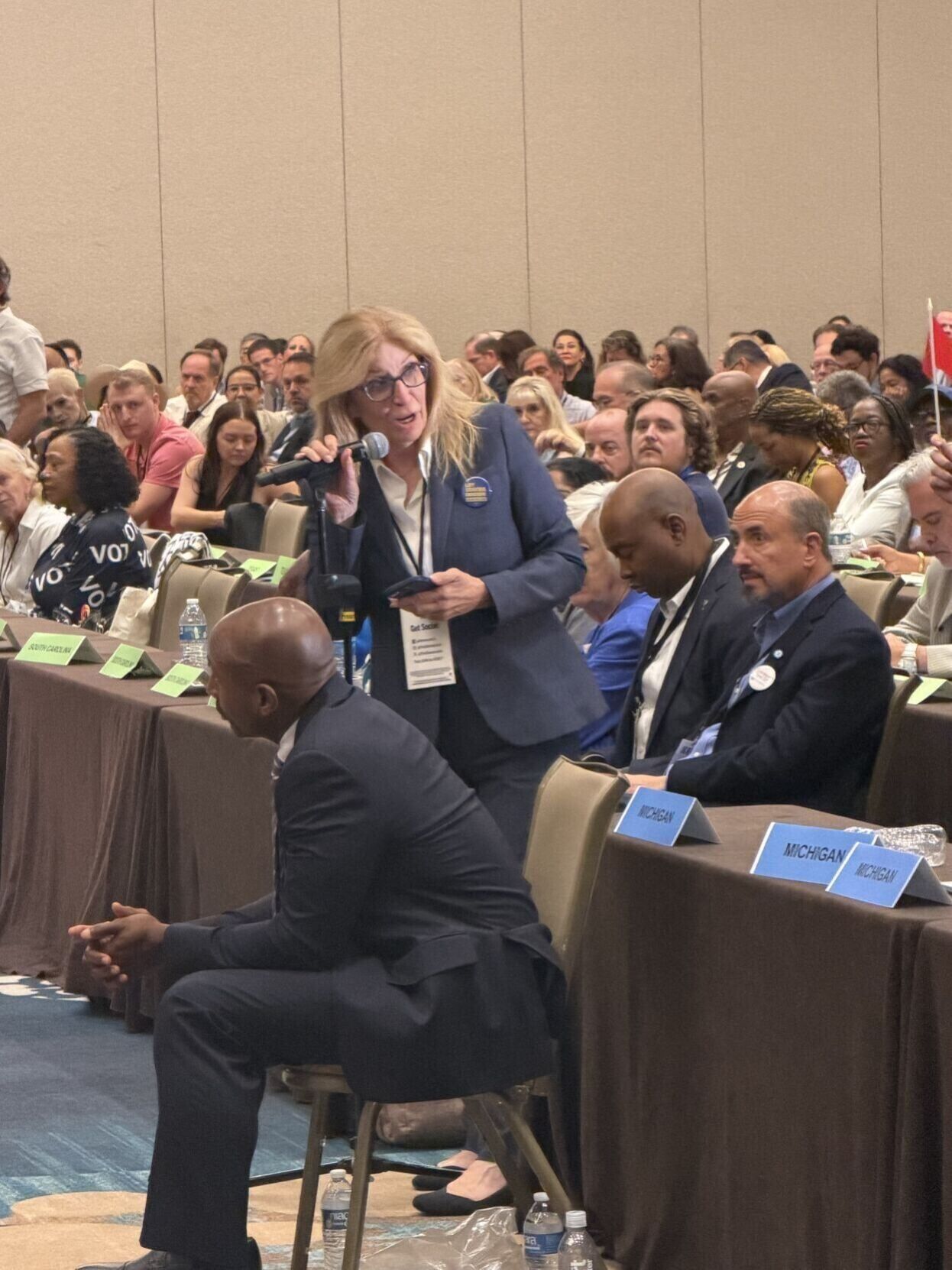
Iowa Democratic Party Chair Rita Hart speaks in opposition to the proposed 2028 early presidential calendar on Saturday, Aug. 15, 2026.
The Iowa Democratic Party maintains its position that it will not decide whether to comply with the calendar until after the November election.
Iowa had kicked off Democrats’ presidential nominating process every four years from 1972 through 2020 before the DNC removed the state from its early window ahead of the 2024 election.
The vote to approve the nomination calendar was passed by an overwhelming majority, with few voicing “nay.” Hart was the only delegate who spoke in opposition to the calendar.
“The DNC has delivered a 2028 nomination calendar that truly represents our party and our values and will help us retake the White House in 2028,” DNC Chair Ken Martin said. “I applaud the Rules and Bylaws Committee for their commitment to a transparent and fair selection process, which led to this rigorous, fair and efficient early window.
Martin also emphasized the diversity of the calendar, citing the lineup as historic.
The fight over Iowa’s place in the calendar has centered on competing views of what an opening presidential contest should accomplish. Critics have long argued that Iowa is insufficiently representative of the Democratic electorate, that its traditional caucus system was difficult for voters who could not attend at a set time and place and that its complicated procedures and reporting failures in 2020 undermined confidence in the process.
Iowa Democrats counter that the caucuses offer something larger primary states and expensive media markets cannot: a relatively low-cost proving ground where lesser-known candidates can build support through retail campaigning, demonstrate organizational strength and face sustained scrutiny from voters in small towns and rural communities before the race moves onto a national stage.
The decision creates a potentially consequential choice for Iowa Democrats: comply with the national calendar, as they did in 2024, or defy the DNC and risk significantly tougher penalties adopted by national Democrats this year.
Iowa loses its bid
Iowa Democrats sought to regain their traditional place at the front of the presidential calendar after being displaced in 2024.
But the Rules and Bylaws Committee rejected that effort earlier this summer when it selected South Carolina to vote first and chose New Hampshire, Michigan, Nevada, Virginia and New Mexico for the early window.
Michigan prevailed over Iowa and Illinois for the Midwest slot.
Supporters argued Michigan offered Democrats a diverse mix of urban, suburban, small-town and rural voters, as well as a strong union presence and an economy that includes agriculture and manufacturing.
National Democrats have repeatedly questioned Iowa’s demographic diversity, accessibility and ability to administer a caucus after the chaotic 2020 contest, when problems with a new reporting application delayed clear results for days.
Iowa Democrats argued they had addressed many of those shortcomings. Their 2028 proposal called for a simpler, single presidential preference vote, results announced on caucus night and a mail-in option for voters unable to attend in person — eliminating the multiple rounds of realignment and complicated caucus math used through 2020.
Party officials also pitched Iowa’s affordability as an asset. Rather than requiring candidates to immediately spend millions of dollars on television advertising in large media markets, they argued Iowa gives candidates without massive war chests a chance to gain traction by meeting voters face-to-face and building organizations precinct by precinct.
The Iowa Republican Party, whose caucuses retain their first-in-the-nation status within the GOP nominating process, also sharply criticized the Democrats’ decision last month. Iowa GOP Chair Jeff Kaufmann called it “an intentional, focused disrespect of a state.”
Tougher penalties for defying DNC
The decision carries greater consequences than it did four years ago.
National Democrats this summer strengthened penalties for states and presidential candidates that violate the party’s approved calendar, an effort DNC leaders said was intended to establish clear rules before candidates begin entering the 2028 race.
Under the rules, a state that holds an unauthorized early contest would lose 100% of its delegates to the Democratic National Convention rather than the 50% penalty previously prescribed.
States also could face a $270,000 fine.
Presidential candidates who participate in an unauthorized contest could be barred from receiving delegates from any state granted an early-window waiver and prohibited from participating in DNC-sanctioned presidential debates.
The rules also require candidates and their campaigns to denounce outside groups campaigning on their behalf in unsanctioned contests.
And unlike in previous cycles, the penalties cannot later be rescinded by the DNC or the Democratic National Convention.
Martin said that when the tougher sanctions were adopted, eliminating discretion over the penalties would help assure Democratic voters that the national party was not manipulating the nomination.
“We have to give them a sense that our party is not picking winners and losers, that we’re not putting our thumb on the scale,” Martin said in June.
Iowa law complicates next move
The national party rules potentially put Iowa Democrats at odds with state law.
Iowa law requires the state’s precinct caucuses to occur at least eight days before any other state’s presidential nominating contest and requires the caucuses to be conducted in person.
Iowa Democrats navigated that conflict in 2024 by separating their presidential preference process from caucus night.
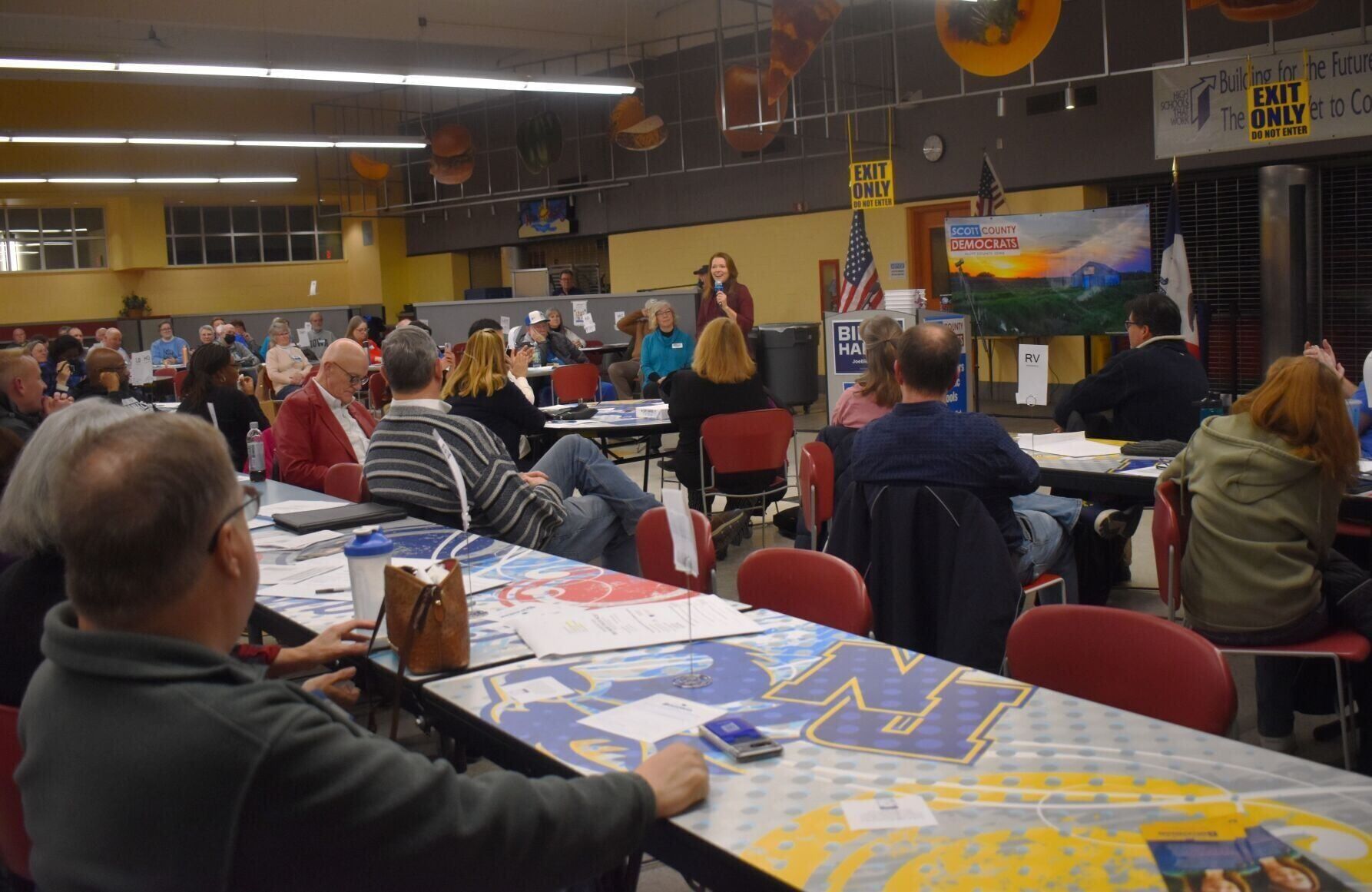
Christina Bohannan — a Democratic candidate for Iowa's 1st Congressional District — speaks to Scott County constituents during an Iowa Democratic Caucus at Davenport North High School on Monday, Jan. 15, 2024.
Democrats held their traditional in-person precinct caucuses for party business while conducting presidential preference voting separately by mail. Results were released on Super Tuesday, keeping the presidential vote within the DNC-approved calendar.
Whether Iowa Democrats will employ a similar arrangement in 2028 remains unresolved.
Scott Brennan, Iowa’s Democratic National Committee member and a former member of the Rules and Bylaws Committee, previously questioned whether the national party’s tougher sanctions would ultimately deter Iowa from holding an early presidential contest.
“I just don’t think that the penalties are sufficient to deter our future elected officials from making decisions that are going to work best for Iowa,” Brennan told The Gazette in June.
Brennan also argued it was premature for Iowa Democrats to decide their course before the November 2026 elections, saying the results could alter Iowa’s political standing and its relationship with the national party.
“Winning in November changes the dynamic on all of this,” Brennan said.
Brennan echoed similar thoughts after the vote, saying that he doesn’t like the approved calendar, but the party is “laser-focused” on November and plans to revisit the calendar then.
Calls to defy national party
Some Iowa Democrats have already argued the state should ignore the national calendar if necessary.
Meanwhile, Democratic U.S. Senate nominee Josh Turek said Friday at the Iowa State Fair that Iowa should continue to hold the first presidential nominating contest regardless of the national party’s calendar.
“Iowa law is clear. We go first, and so I'm in favor of the Iowa caucuses continuing,” Turek told reporters.
Turek pointed to former President Barack Obama, whose victory in the 2008 Iowa caucuses helped propel his campaign for the Democratic presidential nomination. Turek said Obama recently told him that the Iowa caucuses were his favorite part of his presidential campaign.
Obama’s 2008 campaign remains a central example cited by defenders of Iowa’s traditional role. His organization built support through months of campaigning and organizing across the state before defeating better-known rivals in the caucuses, helping establish him as a viable national candidate.
Iowa House Democratic Leader Brian Meyer previously called for Democrats to move ahead with their traditional caucuses regardless of the DNC’s decision, pointing to New Hampshire’s refusal to follow the national party’s 2024 calendar.
“New Hampshire and Iowa were tossed last time,” Meyer said during a 2025 appearance on Iowa PBS’ “Iowa Press.” “They did what they needed to do and what they wanted to do. (The national party) still seated those delegates. At the end of the day, we need to do what we need to do. And I propose that we just move forward with our caucuses as normal.”
That approach would carry substantially greater risk under the rules approved for 2028.
Iowa Democrats themselves have been divided over how aggressively the party should fight for its traditional position.
An Iowa Democratic Party survey released in December found 65.3% of respondents wanted Iowa to be first or otherwise early in the 2028 process.
But 51.1% said the state party should accept the DNC’s decision if Iowa was not selected, compared with 34.4% who favored ignoring the national party and proceeding with an early contest.
End of an Iowa tradition
Iowa’s Democratic and Republican caucuses had opened the presidential nominating season every election cycle beginning in 1972, turning the state into a quadrennial destination for White House hopefuls and giving Iowa activists an outsize role in presidential politics.
The Democratic caucuses came under intense national criticism after reporting and technology failures delayed results from the 2020 contest.
National Democrats subsequently overhauled their calendar, arguing the opening contests should better reflect the racial, geographic and economic diversity of Democratic voters.
Iowa Democrats argued that the caucuses function as an early stress test for presidential campaigns. Candidates are forced to organize across scores of small communities, recruit volunteers and precinct leaders and repeatedly interact with voters in intimate settings where weaknesses can be harder to conceal behind advertising.
Former Iowa Democratic Party Chair Ross Wilburn told the national committee during Iowa’s presentation that abandoning the state allowed Republicans to dominate political attention here.
“Democrats, we can’t afford to continue to let Republicans have the spotlight and the megaphone in Iowa,” Wilburn said.
Saturday’s vote means that the argument was not enough to restore Iowa to the early lineup.
What happens next will depend on whether Iowa Democrats accept the national party’s calendar or decide that preserving their traditional place at the front of the presidential nominating process is worth risking the DNC’s new penalties.