

HHS Secretary Robert F. Kennedy attends signing of ‘Iowa MAHA’ public health bill
U.S. Health and Human Services Secretary Robert F. Kennedy Jr. was in Iowa on Wednesday to celebrate the signing of state public health policy into law. While here he highlighted a newly published U.S. surgeon general warning against the impacts of screen time on children.
Kennedy joined Gov. Kim Reynolds at the Iowa Capitol as she signed into law public health legislation that statehouse Republicans have dubbed the “Iowa MAHA” bill in a nod to the Make America Healthy Again movement spearheaded by Kennedy and President Donald Trump’s administration.
Later Wednesday, Kennedy, Reynolds and Dr. Stephanie Haridopolos, director of national health communications for the Office of the Surgeon General, held a press conference at Gilbert Elementary School to promote a new U.S. Surgeon General’s Advisory that warns of the “harms of screen use” by children.
The new state law limits the amount of time students in kindergarten through fifth grade can be taught on computers, laptops, tablets and other digital devices, a prohibition on digital devices during recess, and an order that the Iowa Departments of Education and Health and Human Services create and support a work group to “examine research related to the impact of school-provided technology on the cognitive function and academic performance of students in grades six through twelve.”
“Iowa is leading the nation by taking decisive action to protect children’s health, including limiting excessive classroom screen time,” Kennedy said during the press conference in Gilbert.

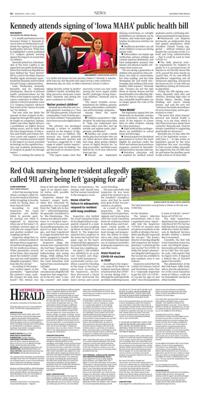
U.S. Health and Human Services Secretary Robert F. Kennedy Jr. watches while Iowa Gov. Kim Reynolds talks about during a news conference Wednesday, May 20, 2025, at Gilbert Elementary School in Gilbert.
‘Better protect children’
Kennedy described the new surgeon general’s warning as a “tool kit” that gives parents, schools and communities “tools to better protect their children” from potential harm from excessive digital device use.
Iowa Gov. Kim Reynolds and U.S. HHS Sec. Robert F. Kennedy, Jr. talk about newly published guidance from the U.S. Surgeon General's Office reg…
The advisory was developed through a review of available research on the impacts of digital device use on children. The research was found primarily through electronic searches and “resources suggested by a wide range of subject matter experts.” The report notes its findings “are not the result of a formal systematic review.”
“The report makes clear that excessive screen use now ranks among the most urgent public health challenges facing American children,” Kennedy said in Gilbert.

Flanked by U.S. Health and Human Services Secretary Robert F. Kennedy Jr. and Iowa Gov. Kim Reynolds, Dr. Stephanie Haridopolos, director of national health communications for the Office of the Surgeon General, talks about newly published guidance from the U.S. Surgeon General’s Office regarding students’ screen time during a news conference Wednesday, May 20, 2026, in Gilbert.
The report includes recommendations for children, parents, schools, policymakers, and healthcare and technology companies.
Among them, the report suggests:
Children can perform a “digital detox” by reducing screen time to “help you understand how screens affect your life,” and “go outside and explore parks, playgrounds, and libraries.”
Families can create a family media plan that includes who can use which devices when and for how long, delay giving children access to digital devices for “as long as possible,” and limit screen time for six- to 18-year-olds to two hours per day.
Schools can implement daylong restrictions or outright prohibitions on cell phone use by students, and create more opportunities for physical activities for students.
Healthcare providers can ask about children’s screen use during regular visits.
Policymakers can require age verification, privacy settings and content exposure limitations, and fund independent research into mental and physical health outcomes from screen use.
“We are raising a generation of children who spend less time outdoors, less time in conversation, less time reading, and less time developing the real-world relationships and resilience that every healthy child requires,” Kennedy said. “Screens are not the only driver of chronic disease and the mental health crisis affecting children, but they’re a major contributor, and public health leaders can no longer ignore the scale of the problem.”
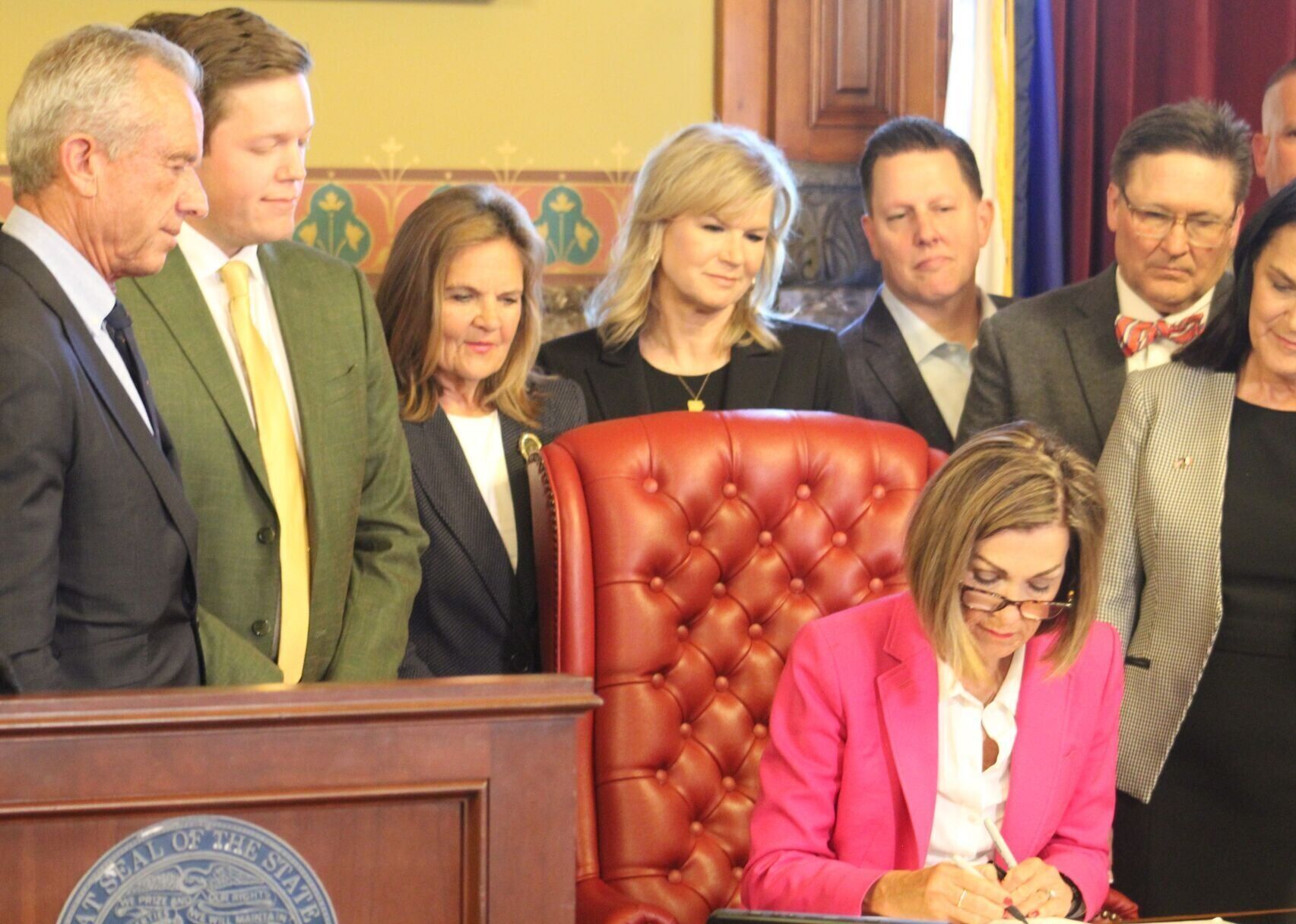
Health and Human Services Secretary Robert F. Kennedy Jr. watches as Iowa Gov. Kim Reynolds signs into law public health legislation during a bill-signing ceremony Wednesday, May 20, 2026, at the Iowa Capitol in Des Moines.
‘Iowa MAHA’
The legislation signed into law Wednesday by Reynolds contains many provisions, including the study of the impacts of screen time on older students. Among the other provisions:
Eight artificial dyes and ingredients are prohibited in school meals and beverages.
Annual requests to the federal government to restrict the foods eligible for purchase under the SNAP and summer food assistance programs, enacted by Reynolds’ administration, become state law.
Nutrition education will be required for medical school graduates and in continuing education requirements for physicians.
Pharmacists can dispense ivermectin, an antiparasitic drug that gained prominence when President Donald Trump suggested — without evidence and despite the conclusion of the U.S. Food and Drug Administration — that it could be used to treat COVID-19.
The daily physical activity requirement for students in grades K-4 is increased from 30 minutes to 40.

In order of appearance: Iowa Gov. Kim Reynolds, U.S. HHS Sec. Robert F. Kennedy, Jr., Iowa. Sen. Kara Warme, and Iowa Rep. Austin Harris speak…
The bill, House File 2676, passed the Iowa Senate on a party-line, 30-16, vote with all Republicans supporting and all Democrats opposing, and passed the House on a 61-31 vote with one Republican joining all Democrats in opposition.
During the bill-signing ceremony, Reynolds cited data and statistics showing high rates of chronic illness, obesity, binge drinking and cancer among Iowans, and said the new law “advances the health and wellness for every Iowan today, and for generations to come.”
“We know that when Iowans’ physical and mental health is strong, so is our state, which is why these issues have always been a priority,” Reynold said. “And we remain committed to supporting good health for all Iowans.”
Reynolds has 30 days after the end of the legislative session — until June 2 — to take action on legislation passed by the Iowa Legislature this year. According to state records online, Reynolds has signed into law 129 bills thus far and before the deadline needs to take action on 76 more bills.