

Zach Lahn, Rob Sand debate in Sioux City takes a break from campaign attacks

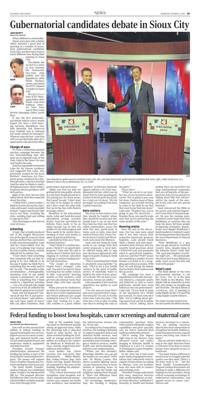
Iowa Republican gubernatorial candidate Zach Lahn, left, and Iowa Democratic gubernatorial candidate Rob Sand, right, shake hands prior to a debate in Sioux City on Wednesday, Oct. 14, 2026.
What a difference a week makes.
About seven days after a debate which featured a good deal of sparring on a number of issues, Iowa gubernatorial candidates Zach Lahn and Rob Sand struck a much different tone during their meeting in Sioux City.
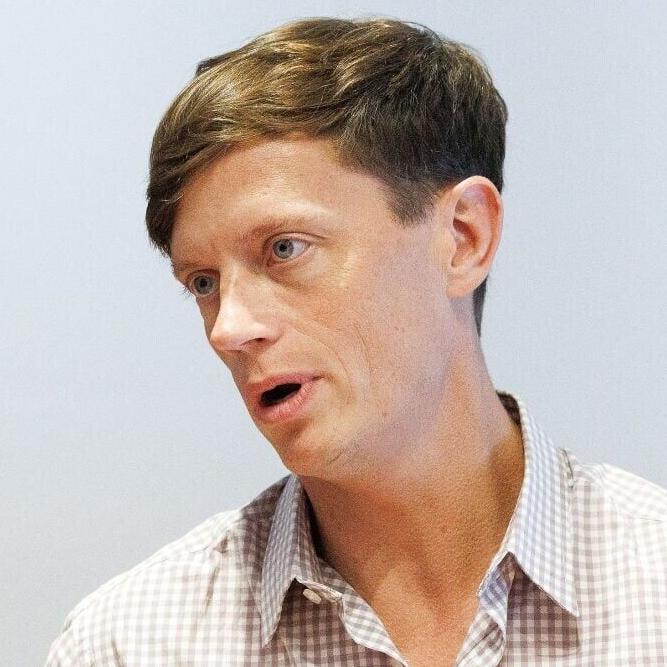
Sand
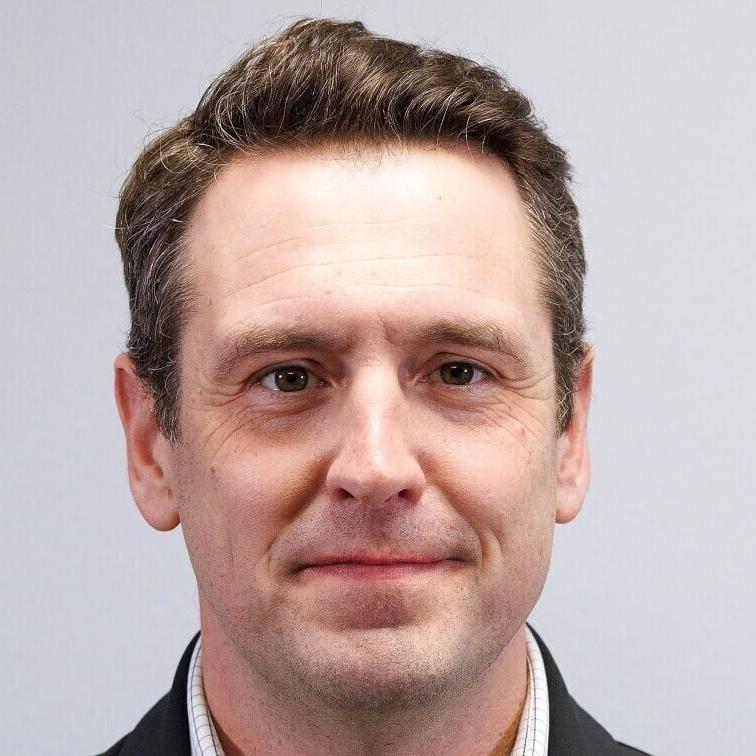
Lahn
The debate, the second in a series of four between the Democratic two-term state auditor and the Republican Belle Plaine business owner, was held in the KTIV Channel 4 studios in Sioux City.
Moderators were KTIV Managing Editor Matt Breen, Gray Iowa Political Director Dave Price and N'West Iowa Review Managing Editor Justin Rust.
It was the first gubernatorial debate held in Iowa's fourth largest city since a 2018 meeting between Republican Gov. Kim Reynolds and Democrat Fred Hubbell and it followed last week's debate in Davenport. Whoever wins the Nov. 3 election will succeed Reynolds after she's spent nearly a decade in the office.
Change of pace
It's been a contentious general election campaign between the two fortysomething men who grew up on opposite ends of the state, Lahn in the Sioux City area and Sand in Decorah.
Sand has repeatedly hammered Lahn for his Kansas residency and suggested that Lahn, who previously worked for the Koch Brothers' Americans for Prosperity group, would not be a full-time governor. Lahn has attacked Sand for what he thinks is Sand's disingenuousness about being a moderate who has problems with both parties.
Right at the start, the two men talked about what they respected about the other.
"I think Rob's a hard worker. I think he travels all over the state," Lahn said in part. Sand responded in kind: "I appreciate the fact that you’re out there, traveling the state, working hard and willing to sign up for this."
They then began to dive into an array of issues.

Democratic Iowa gubernatorial candidate Rob Sand answers questions from the Sioux City Journal editorial board during an interview Wednesday, …
Schooling
A topic that actually produced one of the longest discussions was on the specific issue of school lunches and how they can be more locally sourced and paid for. Lahn said he's heard plenty that the issue of localizing food sources for Iowa's public schools could be difficult but he relishes that.
"I love when I find something that somebody tells me that it’s going to be very difficult to do because it makes me think that is something that we really need to do," he said. "The benefits to this are tremendous ... Having healthy, nutritious food in our public schools is paramount," he said. "This is something that I think would be a bipartisan initiative … I see a lot of people who might want to try it but are stifled by the idea that it’s going to be too hard."
Sand, who has proposed "universal all-day Pre-K and universal school meals," said addressing such basic needs of Iowa's kids can affect behaviors, their performance and much more.
"Make sure that our kids are getting fed in Iowa public schools in a way that’s beneficial and we’re also paying less for those meals, that’s good," he said. "I don’t want my boys to be hangry in school and I don’t want the other kids that are in the class with them to be hangry either."

Iowa Republican gubernatorial candidate Zach Lahn answered questions from media about a massive state steel plant proposal, what he's learned …
Elsewhere in the educational realm, Lahn and Sand discussed educational savings accounts (ESAs). Sand has said before he believes there needs to be an upper-income cap on who can qualify for the state program and there needs to be careful documenting of how such money is spent by private institutions.
Lahn believes ESAs are a "foundational freedom."
"I don’t think it’s a welfare program, I think it’s an opportunity program," Lahn said. He said as well he doesn't believe that Iowa slipping in national education rankings is owed to funding matters but innovation.
"The model of education largely hasn’t changed," Lahn said. One pitch he had for those watching was for public schools to offer "concurrent" learning models so that students could get into educational tracks that better align with their specific needs.
When pressed by moderators on what sort of percent raise he'd like to see on state supplemental aid, which addresses per-pupil funding for Iowa’s K-12 schools, Lahn said "Asking for a specific number is a great debate question." In February, Reynolds signed a bill for a 2% State Supplemental Aid rate, which was up about $160 in state spending per student from the prior fiscal year for a total cost of about "$8,148 per pupil" (according to the Iowa Capital Dispatch).
Data centers
The issue of data centers, how they should be funded, where they should be located and who should have a say on the form they take has been one that has roiled communities across the state this year, particularly in towns such as Salix, Iowa (just south of Sioux City), Sioux Center (in Sioux County) and Woodward, Iowa (near Des Moines).
Sand said one thing he really wants to see change with data center proposals is local public officials being able to sign non-disclosure agreements with large tech giants looking to build in the state.
"This is something that I think is absolutely unacceptable," he said. "That to me is just totally contrary to the spirit of public service. If somebody wants to build in the state of Iowa, great. Let us know. We can have a conversation. Iowans are adults."
Lahn remarked at how loud the opposition has gotten to such projects.
"I’ve not seen an issue that’s had such a narrative that’s negative toward it," he said. As for the state's role, Lahn was clear: "The state has a role to play to make sure they’re setting the rules of the game."
Those rules?
"What we can do is say number one, no tax incentives whatsoever. You’re going to pay your fair share. I believe many of these companies are actually starting to come to the table to say that they want to pay their fair share," Lahn said. "Number two, you’re going to pay the electricity … Number three, you need to make sure that you’re protecting the water quality of the state."
Running mates
Near the end of the discussion, the two men were asked why it was they choose their respective lieutenant governor hopefuls. Lahn picked Derek Wulf, a farmer and state representative from Hudson who has recently faced questions about a $540,000 loan and payments owed to agricultural suppliers. Lahn has said that Wulf's issues are something a number of Iowa farmers can relate to in a struggling agricultural economy. With that, he said during the debate that he thinks Wulf understands the ag sector.
"My campaign has been a repudiation of the idea that special interests, corporate giants and lobbyists as well as career politicians, should have more influence over our government," Lahn said. "If you look at some of the legislation he's (Wulf) put forward, it's been Iowa first bills. You're talking about getting more food served in public schools. You're talking about ending these tax incentives for large multinational companies that are cutting jobs of the people in the state of Iowa and you're talking about bills that will prioritize the needs of the people in the state over the special interests."
Sand referenced the Bible in his answer and said how important it is for there to be peacemakers. He sees his running mate, Crawford County Supervisor Dave Muhlbauer, as someone who can keep the peace between people of opposing viewpoints. Republicans have dinged Muhlbauer's family feedlot in Crawford County for having previous been fined by the Iowa Department of Natural Resources.
"Dave Muhlbauer is a guy who can get elected in Crawford County, Iowa, despite being in the minority there," Sand said. "We need peacemakers in politics right now … We need people who know how to put differences aside, reach across the aisle and work with people."
What's next
The third debate of the Iowa gubernatorial election is set for 7 p.m., Oct. 21, at the Iowa PBS studio in Des Moines. That debate will air statewide on Iowa PBS and stream on iowapbs.org and YouTube. The final debate is a 6:30 p.m., Oct. 27 meeting in Cedar Rapids. KCRG-TV9 and The Cedar Rapids Gazette will host.
This report includes materal from the Lee-Gazette Des Moines Bureau.