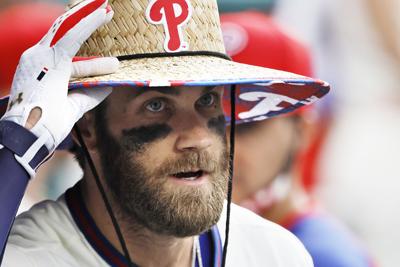

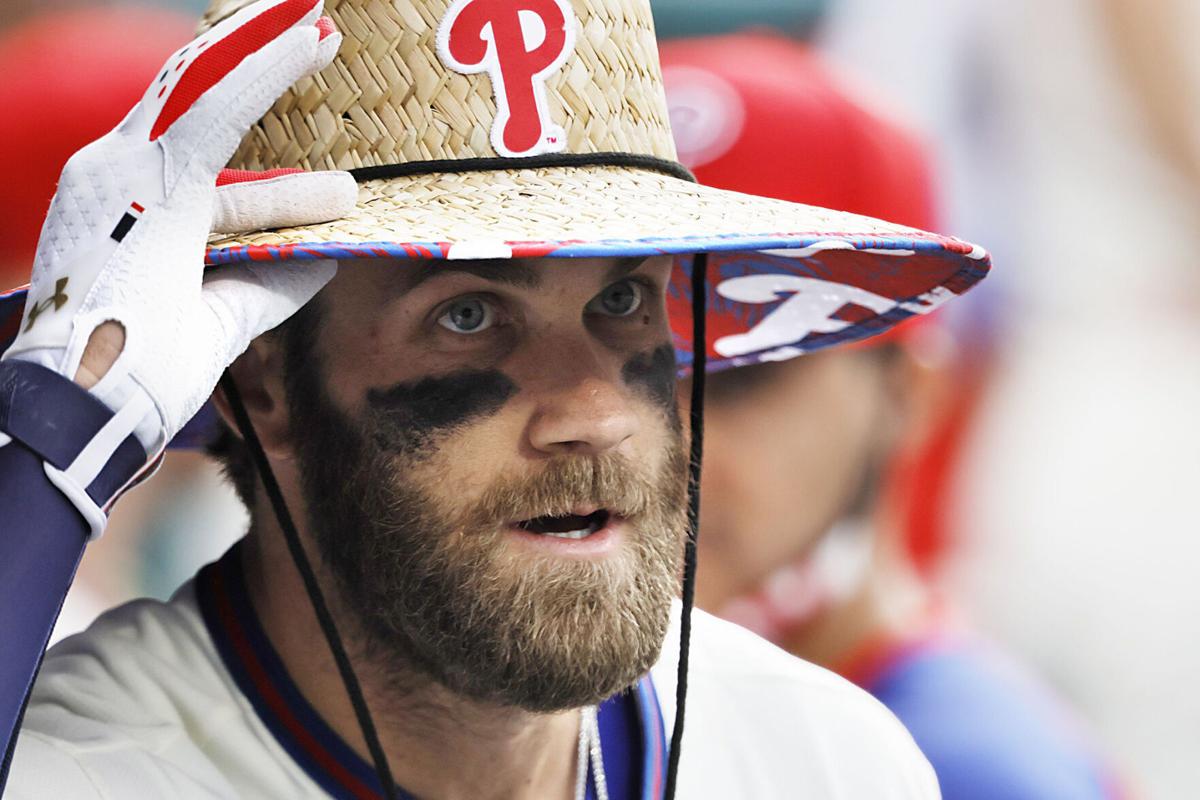
It began with Bryce Harper’s first at-bat Friday night, continued through his home run Sunday, and might persist for another eight weeks — who knows, maybe longer? — as the rhythmic drumbeat at Citizens Bank Park.
People are also reading…
MLB traditions that make the game unique
Presidents throwing the first pitch

The ceremonial first pitch is a baseball tradition that marks the beginning of the game. The first president to throw out the ceremonial first pitch was then-Governor William McKinley in 1892. The presidential first pitch on opening day was started by President William Howard Taft in 1910 at the Washington Senators’ opening day. But the first pitch looked different back then — it was thrown from the grandstands and not from the pitcher's mound. The first president to throw from the pitcher’s mound was Ronald Reagan at the Wrigley Field in 1988.
Seventh inning stretch

The tradition of the seventh inning stretch is one most baseball fans look forward to every game. The seventh inning stretch is the traditional extended break in between the top and bottom half of the seventh inning. The history of the seventh inning stretch is questionable. Some historians credit President Taft, who notably stood up to stretch his legs in the middle of the seventh inning in 1910.
The K’s

The use of the letter “K” as a reference to a strikeout in baseball started with sportswriter Henry Chadwick, who published rule books and annual guides and created statistics such as batting average and ERA. Chadwick used either the first or last letter of key words in his scoring scheme, using K to represent “struck out” because it’s the last letter in “struck.” Today, fans hang “K” signs after opposing teams strike out.
‘Take Me Out to the Ball Game’

An event that has evolved from the tradition of the seventh inning stretch is the singing of “Take Me Out to the Ball Game.” The song was written by Jack Norworth while riding a New York City train in 1908. The song gained popularity when White Sox announcer Harry Caray started singing it during the seventh inning stretch instead of the solo organist performance.
Bleacher creatures roll call

Bleacher creatures are New York Yankee fans who occupied sections 37 and 39 in the old Yankees Stadium and section 203 of the right-right bleachers in the new Yankees Stadium. The bleacher creatures have a tradition to yell the starting lineup during the top of the first inning while the Yankee players are on the field. The tradition started in 1998 when the bleacher creatures would announce the Yankees starting outfielders. When “Megaphone John” started orchestrating the roll call, he included the infielders by using his foghorn voice.
Rally caps

The first known rally cap was seen during the 1945 World Series when the Detroit Tigers flipped their hats inside out hoping for a rally against the Chicago Cubs. The Tigers magically started a comeback and ended up winning the World Series. About 40 years later, during the 1985 season, the New York Mets players donned rally caps and the fans started to copy the players. That’s when the baseball trend took off.
Cracker Jacks

The caramel-coated popcorn-and-peanut snack known as Cracker Jack has been served at baseball games since 1896, according to historian Tim Wiles. The snack wasn’t served at an MLB game until 1907, one year before Norworth included the snack in the lyrics of “Take Me Out to the Ball Game.”
Keeping score

Sportswriter Henry Chadwick, the creator of baseball statistics and scorekeeping, designed the first scorecard grid. Chadwick’s original scorecard was nine batters deep and nine innings wide. Chadwick used codes to indicate what the batter did and which fielder handled the ball. Most of Chadwick’s scoring codes, such as the “K,” are still used today. Keeping score has become a tradition for baseball fans to follow and be a part of the game.
Brewers’ sausage race

The sausage race at the Milwaukee Brewers game started as a virtual race on the scoreboard at County Stadium. When the Brewers moved to Miller Park, the virtual race was thrown out in favor of actual sausage costumes. The sausage race now consists of five sausages (brat, chorizo, hot dog, Italian sausage and Polish sausage) running from the left field foul pole to home plate. The Italian sausage is the all-time winner through September of 2020.
National anthem

The first documented American sporting event to play “The Star-Spangled Banner” was a baseball game in 1862 during the Civil War and before the song was labeled the national anthem. The tradition of playing it before games gained popularity during World War II.
Throw it back

The tradition of fans throwing back home runs hit by visiting players started with Chicago Cubs fans. Any Cubs fan who caught an opposing teams’ home run knew to throw it back onto the field. The tradition dates back to 1969 when a fan in the bleachers caught a ball hit by Hank Aaron and chucked it back onto the field because of a rejection of trying to return a ball to Aaron a year earlier. It didn’t help that it was a crummy year for the Cubs.
‘Sweet Caroline’

The tradition at Fenway Park is to play Neil Diamond’s recording of “Sweet Caroline” prior to the bottom of the eighth inning during every home game. The tradition began during a 1997 game when a Fenway employee in charge of ballpark music played the Neil Diamond hit because she knew someone who recently had a baby named Caroline. The song found a permanent home in the bottom of the eighth inning when Charles Steinberg became the Red Sox executive vice president and suggested it become tradition.
Opening day in Cincy

Teams often switch between home and away every opening day, but not the Cincinnati Reds. MLB opening day is always in Cincinnati. It’s not an official baseball rule, though it is a tradition. The Cincinnati Reds have started every season in Cincinnati since 1876, and it’s because of the weather. According to Reds historians, Cincinnati is always the opening city because it is a southern city.
Angels’ rally monkey

The rally monkey is a tradition started by the Los Angeles Angels in 2000. In a game against the San Francisco Giants, the video board operators played a clip of a monkey jumping up and down along with a clip from Jim Carrey’s “Ace Ventura: Pet Detective.” In the ninth inning, the operators played the clip again with the words “rally monkey” above it. The Angels completed a comeback and the rally monkey remained a fixture.
McCovey Cove

The section of the San Francisco Bay beyond the right field wall of Oracle Park is known as McCovey Cove after Giants first baseman Willie McCovey, who routinely hit home runs into the water. Fans started to line their boats and kayaks waiting for the next home run to splash into the water. Even though the body of water was named after McCovey, the area was made popular by Giants’ legend and home run king Barry Bonds, who hit 35 baseballs into McCovey Cove.
Presidents race

Similar to the Brewers’ sausage race, the Washington Nationals designed their own version of the race. Instead of sausages, the Nationals race four presidents: George Washington, Thomas Jefferson, Abraham Lincoln and Theodore Roosevelt. The race became a team tradition on July 21, 2006, in the middle of the fourth inning. If the game goes into the 13th inning, the presidents get suited up and race again. Teddy Roosevelt is the all-time champion with 35 wins.
W flags

The original W flag affiliated with the Chicago Cubs didn’t mean “win” until 1938. Before that season, the W referred to Wilmington Transportation Co., a company purchased by William Wrigley Jr. The Cubs continue to fly the W flag when the Cubs win a game to let passengers on the “L” train know if the Cubs won or lost that day.
New York Mets home run apple

The New York Mets added the home run apple to Shea Stadium in 1980. New team owners were looking for ways to attract fans back to the stadium after a long stretch of losing seasons. The Mets encased the home run apple in an oversized top hat in center field, and the apple would appear from the hat after a Mets player hit a homerun. The apple became a staple in Mets tradition. When the team moved into Citi Field, the apple found a new home but the tradition continued.
Houston Astros home run train

Train tracks were installed 90 feet above the field at Minute Maid Park in 2000. A 15-foot-high and 56-foot-long replica of an 1862 steam locomotive makes a 40-second trip back and forth on its track every time an Astros player hits a home run. Every time an Astros score a run, the train sounds its bells and whistles.
‘OK, Blue Jays’

The seventh-inning stretch at Rogers Centre in Toronto doesn’t play the typical “Take Me Out to the Ball Game.” The Blue Jays have a signature song called “OK, Blue Jays” that plays during the seventh inning stretch. The song was first released in 1983 by Canadians Jack Lenz and Tony Kosinec.
‘Big Mac Land’

The St. Louis Cardinals named left-field section 272 “Big Mac Land” as a tribute to former first baseman Mark McGwire. Whenever a home run is hit in that section, everyone at the game is entitled to redeem their ticket for a free Big Mac at all participating McDonald’s.
The Ivy

When baseball fans think of Chicago’s Wrigley Field, they often think of the ivy on the outfield wall. Cubs president William Veeck planted the ivy against the brick outfield wall in 1937. The ivy has made an appearance in Wrigley Field every season since, and even has its own rule. If a ball is stuck in the ivy, it is an automatic ground-rule double.