

Iowa property tax legislation moving, but final agreement elusive
House, Senate pushing two options

Iowa Republican state lawmakers must now come together to close the gap on dueling proposals to lower Iowans’ property tax bills after the House and Senate passed separate versions Wednesday.
DES MOINES — Proposals to limit the growth of Iowa homeowners’ property taxes are again moving in the Iowa Legislature.
But an agreed-upon policy remains elusive as the 2026 legislative session heads into its final weeks.
The push for property tax relief comes as Iowa ranks among the highest-taxed states in the nation for property owners. Iowa has the 11th-highest property tax burden in the country, according to the Tax Foundation, and the 10th-highest effective property tax rate, according to Rocket Mortgage.
Majority Republicans in the Iowa House this week advanced the updated version of their proposal — which has been altered from their original bill to include some provisions proposed by Gov. Kim Reynolds — out of the House’s Ways and Means Committee that covers tax policy.
The week before, Senate Republicans updated their proposal.
The moves show Republicans’ latest attempts to reach an agreement on a bill on which they can all agree and Reynolds will sign into law after they spent the months leading up to the session saying homeowners’ property taxes were their top priority.
The differences in the two policy approaches show that much ground remains to be covered before they will have an agreement.
“Obviously, the two bills are very different. Some philosophy differences there, too,” Iowa Rep. Carter Nordman, a Republican from Dallas Center who chairs the House Ways and Means Committee, told reporters this week. “So all we can do is continue to have those conversations and see if we can get on the same page. But, I mean, to your point, they are very different.”
There is no required end date for the legislative session. The 100th calendar day, when legislators’ per diems expire — a carrot created to incentivize lawmakers to have their work done for the year — is April 21, roughly a month away.
Differing approaches
The divide between the chambers reflects fundamentally different strategies for delivering tax relief.
Reynolds and House Republicans are backing a plan centered on limiting the growth of local government revenue. Their proposal would impose a 2 percent cap on most local government revenue increases, aiming to slow the pace of rising property tax bills without restructuring the system itself.
Senate Republicans’ proposal, by contrast, would take a more sweeping approach by eliminating Iowa’s long-standing property tax “rollback” system and tying revenue growth limits to inflation. Senate leaders argue that more structural changes are necessary to deliver lasting relief.
House Republicans and the governor have opted not to address the rollback system in their proposal, focusing instead on capping local revenue growth — a narrower approach than the Senate’s broader restructuring plan.
Neither legislative proposal has yet been analyzed for their projected fiscal impact by the state’s nonpartisan Legislative Services Agency.

Iowa Senate Majority Leader Mike Klimesh, R-Spillville, talks about legislative property tax proposals during media availability on Tuesday, M…
“Those (recent) amendments will help us kind of narrow down the major talking points and move us in the right direction,” Iowa Senate Majority Leader Mike Klimesh, a Republican from Spillville, told reporters Thursday. “So I feel really good where we’re heading with our conversations.”
House, governor combine proposals
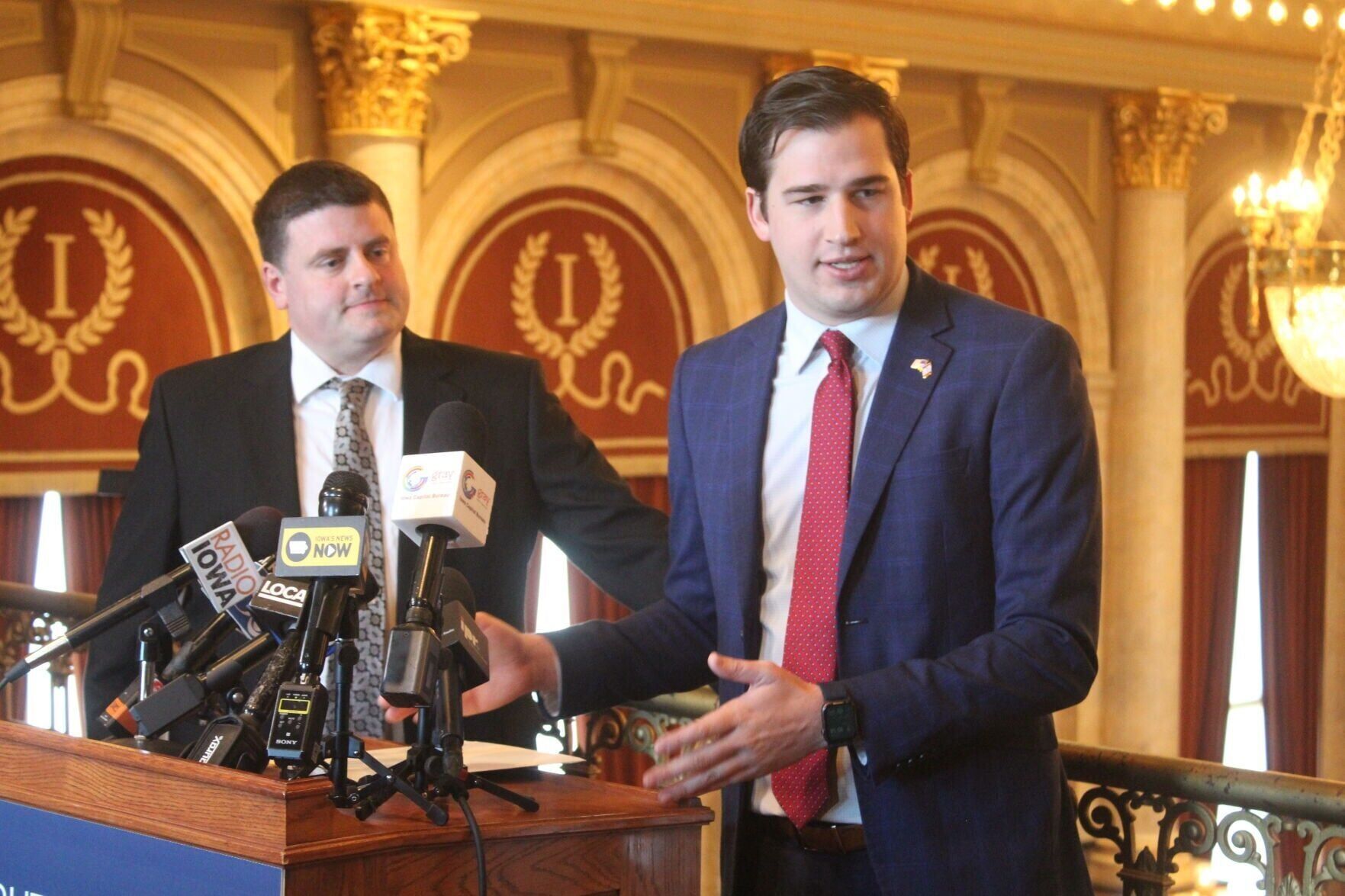
Iowa Rep. Carter Nordman, R-Dallas Center, along with Iowa House Speaker Pat Grassley, R-New Hartford, discusses House Republicans' proposal for local property tax relief during a press conference at the Iowa Capitol in Des Moines on Jan. 21. (Erin Murphy/The Gazette)
The latest version of House Republicans’ proposal would, among other provisions:
Create a residential property tax exemption of 10 percent up to $25,000.
End the state commercial property tax backfill and increase the business property tax exemption from $150,000 to $350,000.
Shift the burden of proof to the assessor when a property owner appeals a valuation, if a property’s value rises 10 percent without any structural changes or updates.
Limit future tax increment financing districts to 20 years.
Limit local government reserve accounts to 35 percent of the current budget, and limit to 35 percent the unspent balance of a school district requesting modified supplemental funding for enrollment growth.
Prohibit property tax bonds from being used to cover general operations.
Nordman, during a House Ways and Means Committee meeting on Wednesday in which the bill was considered and advanced, said the proposal is designed to give homeowners “predictability and stability.”
Addressing concerns expressed about the proposal’s impact on local government revenue and services, Nordman said that too much of the property tax discussion over the past year has been “about the taxing entities and not the taxpayer.”
After the meeting, Nordman told reporters he believes House Republicans and Reynolds are closer on their proposals but that work would continue between all three parties to reach an agreement.
“We have multiple provisions in (the House bill) that would give relief,” Nordman said, “but also, very importantly, give predictability to taxpayers and a significant savings over the next few years alone on where property taxes are going. You look at the graphs right now, and they’re all almost vertical. What this bill hopes to do is make that (growth) a little straighter and not so steep.”
Senate targets structural overhaul
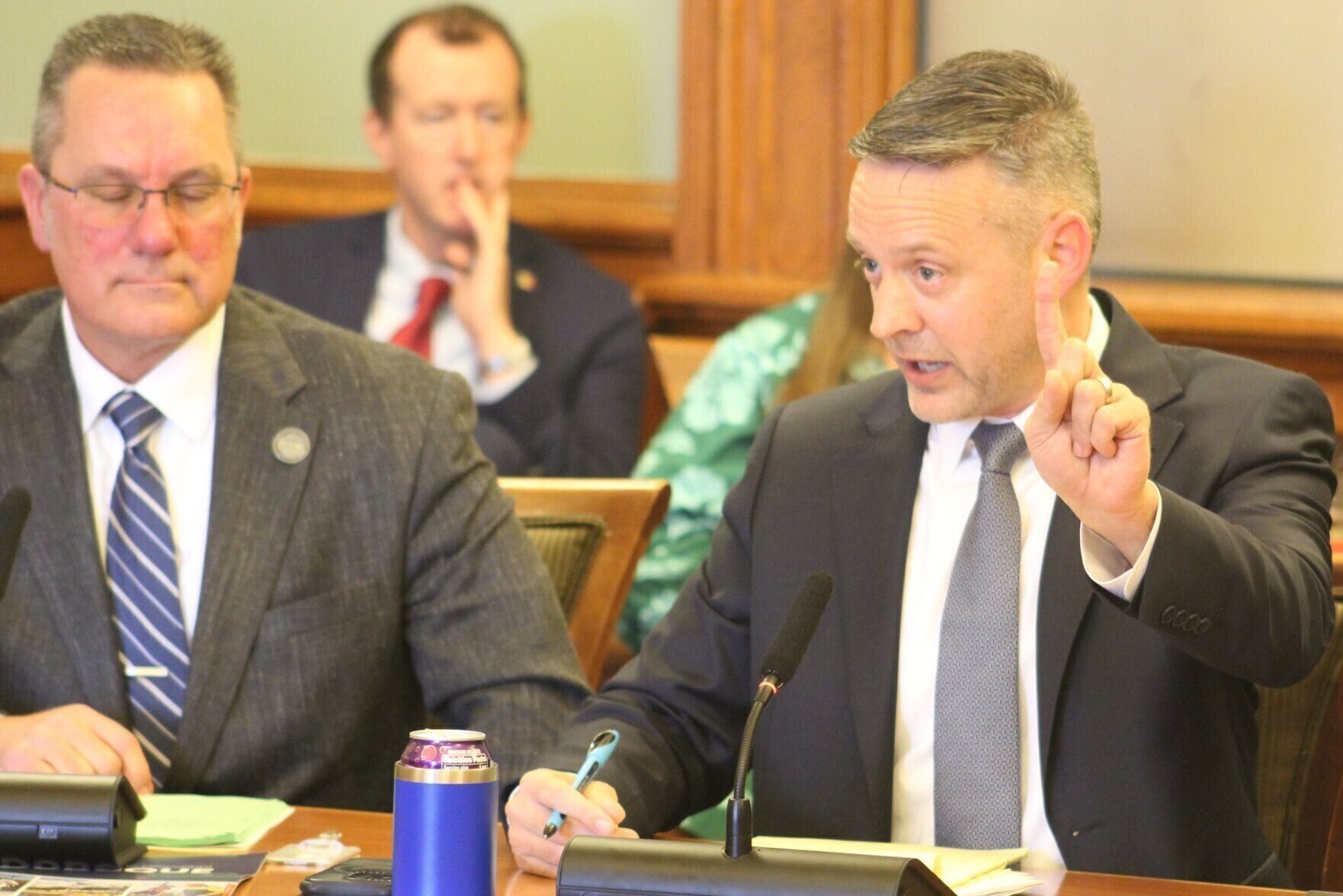
Iowa Sen. Dan Dawson (right), R-Council Bluffs, discusses proposed property tax legislation during a Feb. 25 subcommittee hearing at the Iowa Capitol in Des Moines.
The Senate plan, led by Sen. Dan Dawson, a Republican from Council Bluffs and chairman of the Senate Ways and Means Committee, proposes a gradual but significant reworking of Iowa’s property tax system.
Among its key provisions, the bill would:
Phase out Iowa’s complicated rollback mechanism and replace it with a homestead exemption covering 50 percent of a primary residence’s value, up to $350,000.
Create a pathway to fully exempt property taxes for some older homeowners, eventually allowing 100 percent exemptions for homeowners age 65 and older who have paid off their mortgages.
Shift the full cost of K-12 education to the state, enabling school districts to reduce property tax levies.
Index gas tax revenues and aviation fuel taxes to inflation to support infrastructure funding over time.
The Senate Ways and Means Committee advanced the proposal March 11 with bipartisan support, adopting an amendment that adjusted several provisions while maintaining the bill’s overall structure.
The amendment raised the age threshold for full property tax exemption from 60 to 65 and created a tiered exemption system for older Iowans who still carry a mortgage. For those who still have a mortgage, they would get exemptions that ratchet up by 10 percent every decade, starting with a 60 percent exemption for Iowans in their 60s up to 100 percent for 100-year-olds. It also increased the elderly and disabled tax credit from $1,000 to $1,500.
Dawson has argued that incremental changes will not be enough to address systemic issues.
“People need political courage to tackle this system,” Dawson told reporters March 11. “That’s been one of my gripes I’ve said since Day One. We can do a Band-Aid approach, maybe that’s where it goes … but every person here voting on property taxes better understand we’re going to be back here in two years if we do more Band-Aids because we won’t fix underlying problems in this system.”
He reiterated that sentiment during the committee process.
“I sincerely hope the Iowa Legislature can rise to the occasion and deliver the property tax reform that our constituents — whether it be farmers, whether it be business owners, whether it be homeowners, whether it be seniors — have sent us up here with a mandate to do,” Dawson said.
He also emphasized that the proposal is still evolving.
“We always felt it’s important that we get a bill out from Day One to give Iowans the opportunity to weigh in,” he said. “As we build out this vehicle from the chassis up, or from the ground up, we have some important pieces that we want to introduce into the topic today. This amendment is not the final portion.”
Related

State Sen. Dan Dawson discusses delivering on property tax relief during a legislative forum in Council Bluffs on Saturday, March 14, 2026.