

Iowa House passes bill letting select community colleges offer four-year degrees
The Iowa House passed a bill creating a pilot program that would allow certain community colleges to offer bachelor’s degrees in high-demand fields.
House File 2649 passed the chamber 56-36 on Wednesday.
The bill allows select community colleges to offer as many as three bachelor’s degree programs aimed at addressing workforce shortages. Approved fields include education, nursing, information technology, public safety, business, health care management, agriculture and dental hygiene.
Supporters say the limited pilot program is designed to address workforce shortages while expanding access to affordable bachelor’s degrees in areas without nearby four-year options.
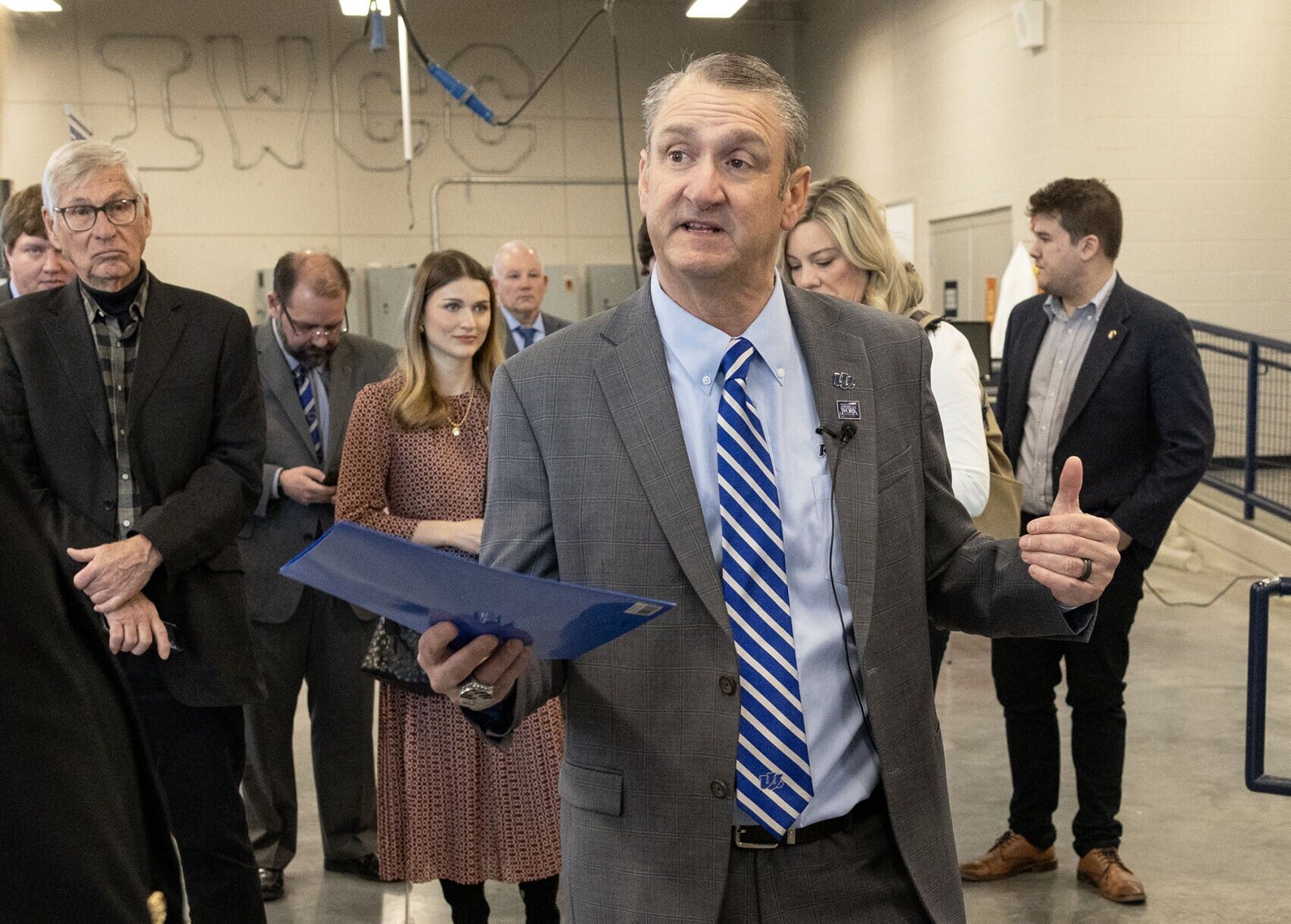
Iowa Western Community College President Dan Kinney shows U.S. Secretary of Labor Lori Chavez-DeRemer around Kinney Hall at the college on Wednesday, Jan. 14, 2026, Iowa Western is interested in offering four year degrees if lawmakers authorize a pilot program this legislative session.
Rep. Taylor Collins, R-Mediapolis, chair of the House Higher Education Committee, said the bill is aimed at expanding affordable higher education opportunities, particularly in rural parts of the state.
“Many of these high-demand careers lack adequate, affordable bachelor’s level pathways in every part of the state, especially in rural Iowa,” Collins said. “This is a barrier that we actually have the power to eliminate with this bill. And this bill moves the needle for household income and helps Iowans reaching for new opportunities.”
The proposal has faced opposition from Iowa’s private colleges, which warned that allowing community colleges to offer four-year degrees could threaten enrollment and financial stability at private institutions. Representatives of the state’s 27 private institutions say community colleges benefit from state support and lower tuition, which they argue would make it difficult for private colleges to compete, and they are already facing enrollment declines.
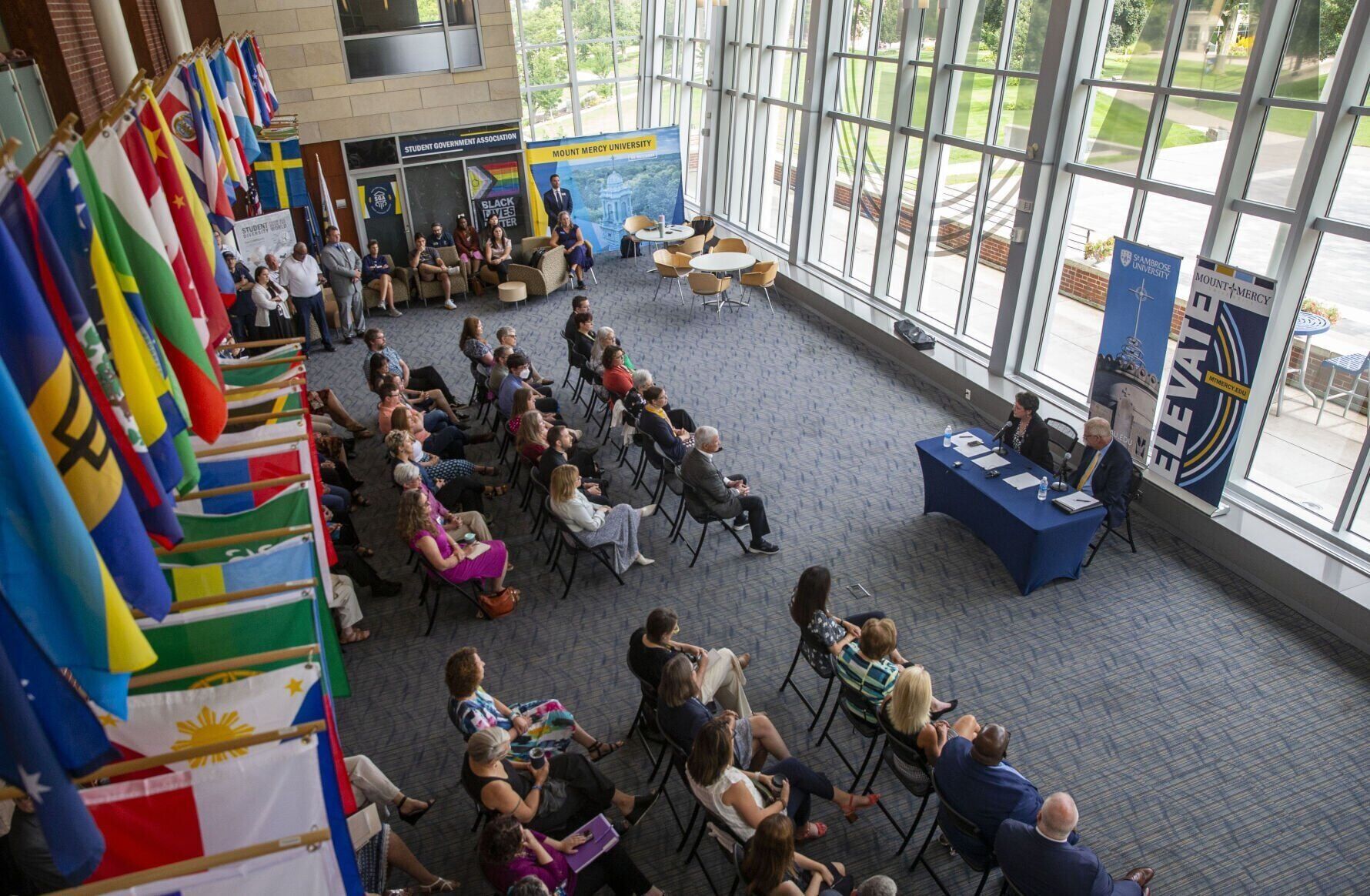
Mount Mercy and St. Ambrose staff members, students and community members listen to President Amy Novak of St. Ambrose University and President Todd Olson of Mount Mercy University talk about the two schools combining during an Aug. 1, 2024, news conference at the Mount Mercy University campus in Cedar Rapids.
In response to those concerns, lawmakers narrowed the bill — limiting the number of community colleges involved, restricting eligible degree programs and requiring a 50-mile distance from existing institutions offering similar programs.
The pilot program would apply to five community colleges: Iowa Central Community College in Fort Dodge, Iowa Lakes Community College in Estherville, Iowa Western Community College in Council Bluffs, Southeastern Community College in West Burlington and Southwestern Community College in Creston.
To qualify, a community college’s main campus must be at least 50 miles from the main campus of a public university or private college offering the same program. Lawmakers adopted an amendment from Collins clarifying that any bachelor’s programs must be offered only at the community college’s central campus.
Under the proposal, tuition for Iowa residents enrolled in a bachelor’s program could not exceed 150% of the lowest tuition charged by Iowa’s public universities for a full-time resident student.
Participating colleges must submit annual reports to the Legislature on enrollment, completion rates, workforce outcomes and program sustainability.
Community colleges previously submitted a report to lawmakers finding that roughly 63% of their instructors already meet qualifications to teach bachelor’s-level courses. However, most are already teaching the maximum number of hours.
The study found that about 42% of jobs in Iowa require a bachelor’s degree, while only about 22% of Iowans hold one. The report also identified “education deserts” in parts of rural Iowa where students lack access to nearby public four-year institutions.
The study concluded community colleges could potentially offer bachelor’s programs but would likely require policy changes, facility upgrades and investments in technology. It recommended a one-time state appropriation of about $20 million over five years to help launch programs. Funding is not included in the bill.
Rep. Jennifer Konfrst, D-Windsor Heights, raised questions during debate about whether the program would receive state funding. Collins said funding discussions still are ongoing. He noted some community colleges have started identifying private sources of funding.
“I just want to encourage my colleagues to … consider the impact on students and institutions in your area, and make sure that if we’re going to offer this program to students who are looking for bachelor’s degrees at community colleges that we actually find ways to fund it,” Konfrst said. “… Because otherwise we’re making a promise to students that we can’t fulfill.”
According to a fiscal analysis from the nonpartisan Legislative Services Agency, the cost to the state is currently unknown and will depend on how many colleges ultimately participate and how quickly new bachelor’s programs are launched. The Department of Education estimates a one-time cost of about $100,000 to update the State of Iowa Curriculum System, the centralized database used to approve and track community college academic programs. Any additional administrative costs are expected to be absorbed by existing staff.
The bill now heads to the Senate for consideration.