

Midterm elections could get more expensive after US Supreme Court vote
Millions of dollars already figured to pour into Iowa’s Congressional campaigns this summer and fall, with an open-seat U.S. Senate election at the top of the ballot plus two or three competitive U.S. House elections.
A recent U.S. Supreme Court ruling may boost spending on Iowa’s federal campaigns even higher.
The Supreme Court’s ruling this week effectively erased limits on how much political parties can spend on and coordinate with candidates for Congress and the president. The federal law — which was more than a half-century old — had been put in place to prevent donors from sidestepping disclosure requirements by donating instead to party organizations.
Before the ruling, parties were limited to spending $65,300 on a U.S. House candidate and $328,900 on a U.S. Senate candidate in Iowa. This week’s high court ruling struck down those limits.
That could mean more spending on Iowa’s federal elections this year, since many of the state’s Congressional campaigns figure to be competitive and play a role in determining which party controls the U.S. House and Senate.
It starts at the top of the ticket, with an open-seat U.S. Senate election. Republican Ashley Hinson and Democrat Josh Turek are running for the seat being vacated by the retirement of Republican U.S. Sen. Joni Ernst. Libertarian Thomas Laehn also is running for the seat.
Central Iowa’s 3rd Congressional District, where Republican incumbent Zach Nunn faces Democrat Sarah Trone Garriott, and Eastern Iowa’s 1st Congressional District, where Republican incumbent Mariannette Miller-Meeks faces Democrat Christina Bohannan, figure to be among the most competitive in the nation. Eastern Iowa’s open-seat 2nd Congressional District, featuring Republican Joe Mitchell and Democrat Lindsay James, also could be competitive.
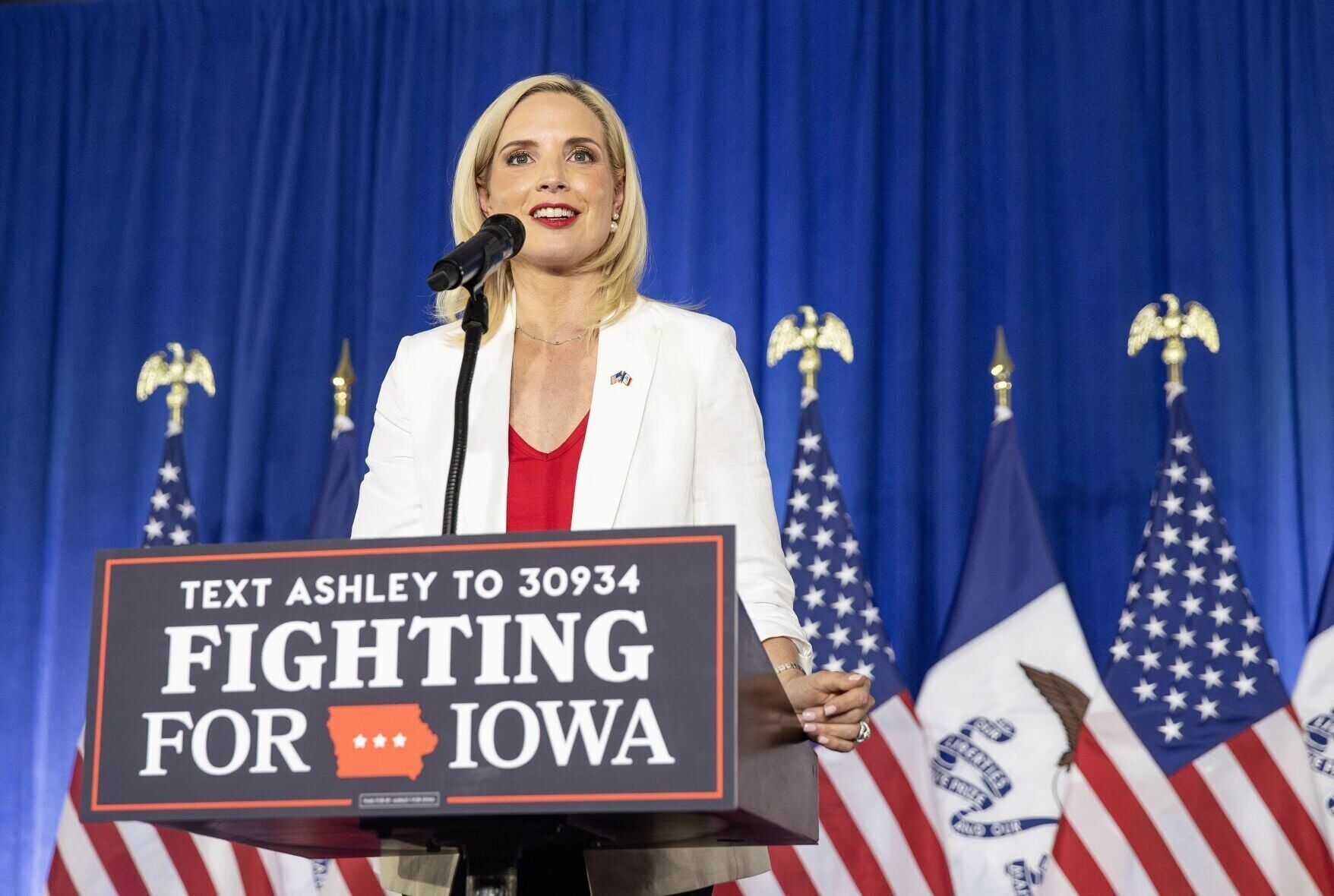
Iowa Republican U.S. Senate candidate and current U.S. Rep. Ashley Hinson speaks after winning the Iowa Senate nomination.
With Republicans holding narrow majorities in both chambers — 53-47 in the Senate and 219-212 in the House — Iowa’s elections could play a role in determining party majorities in both chambers.
And that means those campaigns will be well-funded. And those candidates just got permission to accept even more donations from their national party organizations.
Advocates for limits on spending on U.S. elections decried the Supreme Court ruling, saying it is the latest — joining the 2010 Citizens United decision — to dismantle attempts to limit the influence of money in politics.
“As an organization committed to protecting a free and fair democracy, the League strongly condemns (the) ruling, which dismantles decades-long protections against coordinated spending in campaigns,” said Celina Stewart, CEO of the League of Women Voters in a statement issued after the ruling.
“By eliminating these critical guardrails, the court has opened the floodgates to unlimited political spending that will drown out the voices of everyday Americans,” Stewart said. “This ruling is the latest in a troubling pattern of decisions that prioritize wealthy interests over democracy’s health.”
The most immediate impact in Iowa will be the national parties’ ability to more closely coordinate spending with Iowa’s federal candidates, said professor Joshua Ferrer, an assistant professor of government at American University’s School of Public Affairs.
Large donors can skip the individual donations directly to candidates, which are limited to $7,000, or Super PACs, which can accept unlimited donations but cannot coordinate with the candidates, Ferrer said, and instead contribute hundreds of thousands of dollars to the national party, with the agreement it will spend that on a specific candidate.
In the immediate future — this fall’s midterm elections — the ruling stands to benefit Republicans, Ferrer said, for two reasons: they have a sizable fundraising advantage over Democrats and parties will be able to get heavily discounted TV advertising rates, magnifying that financial edge.
In that U.S. Senate election, Hinson — an incumbent congresswoman — finished May with nearly $6 million in her campaign account, while Turek — who went through a competitive Democratic primary election — had less than $1 million, according to federal campaign finance reports. New quarterly fundraising reports will be published July 15.
“It’s very likely that this decision will increase the fundraising gap for the open (Senate) seat,” Ferrer said. “It looks like in the competitive House races, the candidates have generally raised similar amounts. Once again, the decision will give Republicans a spending edge, since the party has more cash to distribute than the Democratic Party.”
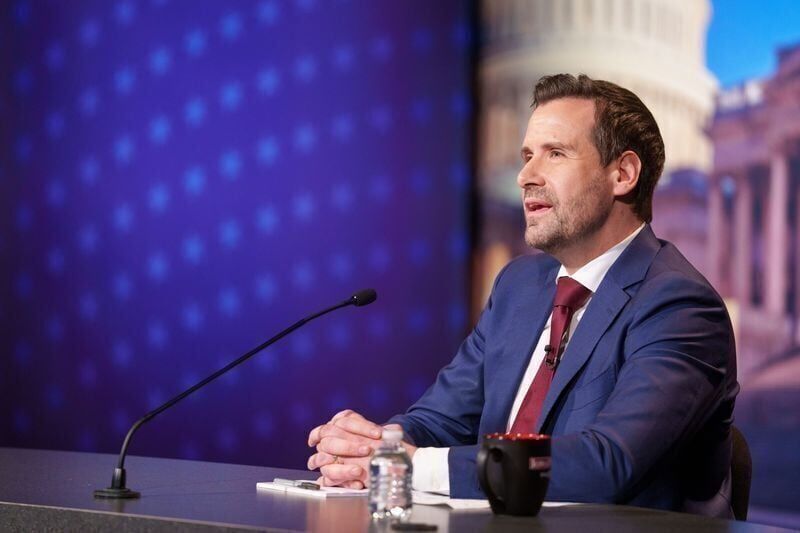
Democratic U.S. Senate candidate Josh Turek participates in a debate with Zach Wahls on May 5, 2026.
And the national Republican Party organizations have more money to spend than Democrats.
At the end of May, according to federal campaign finance reports:
The Republican National Committee had more than $125 million in its account while the Democratic National Committee had less than $15 million.
The Republican National Senatorial Committee had nearly $49 million, while the Democratic Senatorial Campaign Committee had $39 million.
The National Republican Congressional Committee (for U.S. House Republicans) had nearly $82 million to $73 million for the Democratic Congressional Committee.
Ferrer said research shows that fundraising advantages matter, “but only to a point.”
He said research shows it takes a 100-advertisement advantage toward one party to create a 1-percentage-point difference in a statewide election’s outcome, and the effect is closer to 2 points for House elections.
“The average major party Senate candidate runs around 1,700 ads. So the races will have to be very close for this to change the outcome,” Ferrer said.
The general election is Nov. 3.