
Farmers talk tariffs, rising costs, AI at Omaha conference

Charles Baron, co-founder of the Farmers Business Network, demonstrates Norm, an AI Ag advisor at the Farmer2Farmer event at the CHI Health Center in Omaha on Tuesday, Feb. 24, 2026.
Farmers from across the Midwest relayed at an Omaha conference Tuesday that while farming has been a bedrock of civilization, it's a trade that always keeps you guessing.
Two major variables were front and center at the Farmers Business Network Farmer2Farmer Conference at the CHI Health convention center: tariffs and AI.
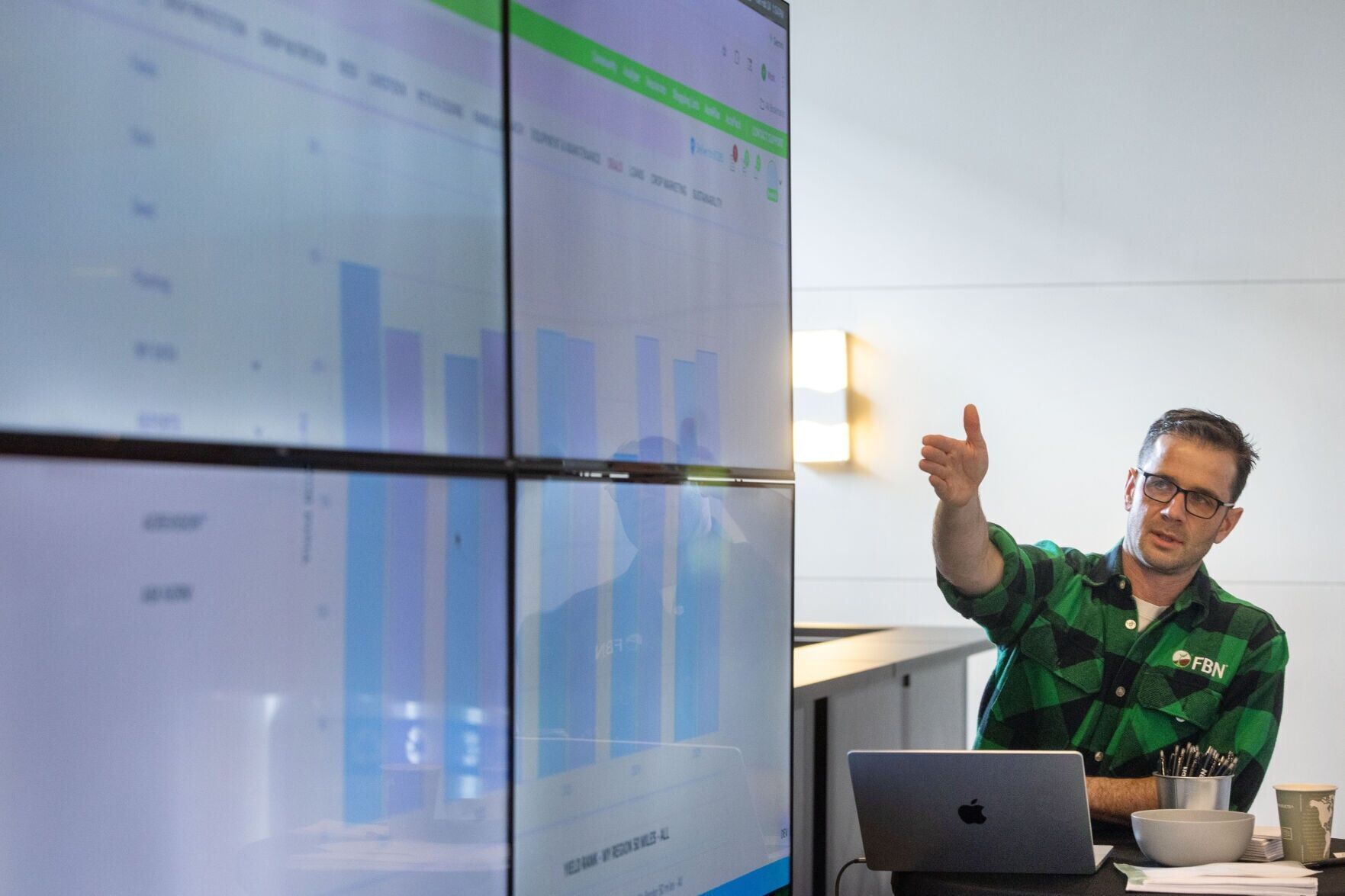
Charles Baron, co-founder of the Farmers Business Network, demonstrates Norm, an AI Ag adviser, at the Farmer2Farmer event at the CHI Health Center in Omaha on Tuesday, Feb. 24, 2026.
Tariffs are a foundational but embattled economic policy for President Donald Trump's administration, with the Supreme Court striking down the tariffs.
Throughout the last year, Omaha area U.S. Rep. Don Bacon has challenged tariffs as illegal. Other federal officials haven't been as vocal, but they united to urge Trump against importing beef from Argentina to lower grocery store prices.
Josh McClure, Farmer Business Network's head of market advisory, said the court's decision has created disarray and a lot of unanswered questions for farmers. He also noted farmers are still dealing with input prices that rose during the pandemic and haven't come back down.
Mark Whitney, a corn and soybean farmer from Trenton, Missouri, was invited to speak on an FBN-organized customer panel and share what it’s like to be a farmer today. He relayed that "It's pretty tough right now. The inputs are so expensive and the prices are low. It's really hard to make ends meet."
Whitney said it was good to strike down the tariffs because there needs to be a bigger customer base to buy goods. However, he was not sure what the result of the court's decision would be, given the fraught relations between the United States and other countries.
"They remove those tariffs, but you still got to be able to have trading partners to buy the products," Whitney said. This year could be a breaking point for his farm, saying that he's been losing about $1 million per year in revenue and that government bridge assistance payments aren't going to be enough to keep going.
Along with foreign trade, he advocated for expansion in ethanol production.
Clark McPheeters, a corn and soybean farmer from Gothenburg, Nebraska, agreed about ethanol production, saying he's in favor of more domestic uses for his crops.
He said he needs to do a full financial analysis, but he does not think the tariffs the past year had much effect on his income. The 2018 trade war felt more difficult, he said.
The main difference was domestic uses for soybeans, noting Nebraska has new crush facilities for soybeans.
McPheeters said he is not opposed to exporting, but he favored domestic applications for crops because foreign trade is “more prone to being a political football.” He also said there is a place for protective tariffs, but the priority should be getting commodity prices higher.
FBN, which strives to put farmers' needs first in the ag industry, deploys technology and information sharing across its network to help account for some of the uncertainty that comes with farming.
Several farmers in attendance noted interest in AI applications to help with operations.
Josh Lloyd from Clay Center, Kansas, said he came to the conference to learn more about AI applications on his farm.
"Part of the issue with farm software is the farming is different from region to region. The software is not connected with the farm, and so farm software's never really did anything you wanted to do," said Lloyd, who grows wheat, corn and beans, along with keeping some livestock.
"I think AI is going to be a big game-changer. It'll take a lot of this data that we have on farm and hopefully kick something out useful for each individual," he said.
Charles Baron, a co-founder of FBN who lives in Omaha, said his team is unveiling an AI tool at the conference that does tailor information for individual farmers.
"AI also underlies not just workflows and decisions, but it underlies seed breeding, robotics, automation, chemical discovery and grain marketing. It's going to help all kinds of aspects of the industry get much more intelligent, and then for a farmer to be able to operate with much more intelligence," Baron said.
McPheeters, who is also an engineer, is attending the conference as a panelist, offering insight on how technology improved the deployment of farm equipment and irrigation.
Innovation and farming go hand-in-hand, he said.
"People ask me a lot how I use my engineering degree," McPheeters said. My job is to think critically and solve problems, and that's what I'm trained to do, and I enjoy it. There's lots of that to do on the farm for sure."