In a stunning upset that would have seemed highly unlikely a year ago, Zach Lahn will be the Republican candidate for Iowa governor after a narrow victory in Tuesday’s primary elections.
Lahn, a business owner from Belle Plaine who moved back to Iowa just more than two years ago, narrowly defeated U.S. Rep. Randy Feenstra of Hull. Lahn narrowly surpassed the 35% share of the vote required by state law to avoid sending the election to a nominating convention.
Lahn will face Rob Sand, a Democrat and the state auditor, in this fall’s general election.
Feenstra conceded to Lahn and gave his concession remarks just before 11 p.m. Tuesday. As of 11:05 p.m., unofficial results had Lahn with about a 1,750 vote lead over Feenstra.
![]()
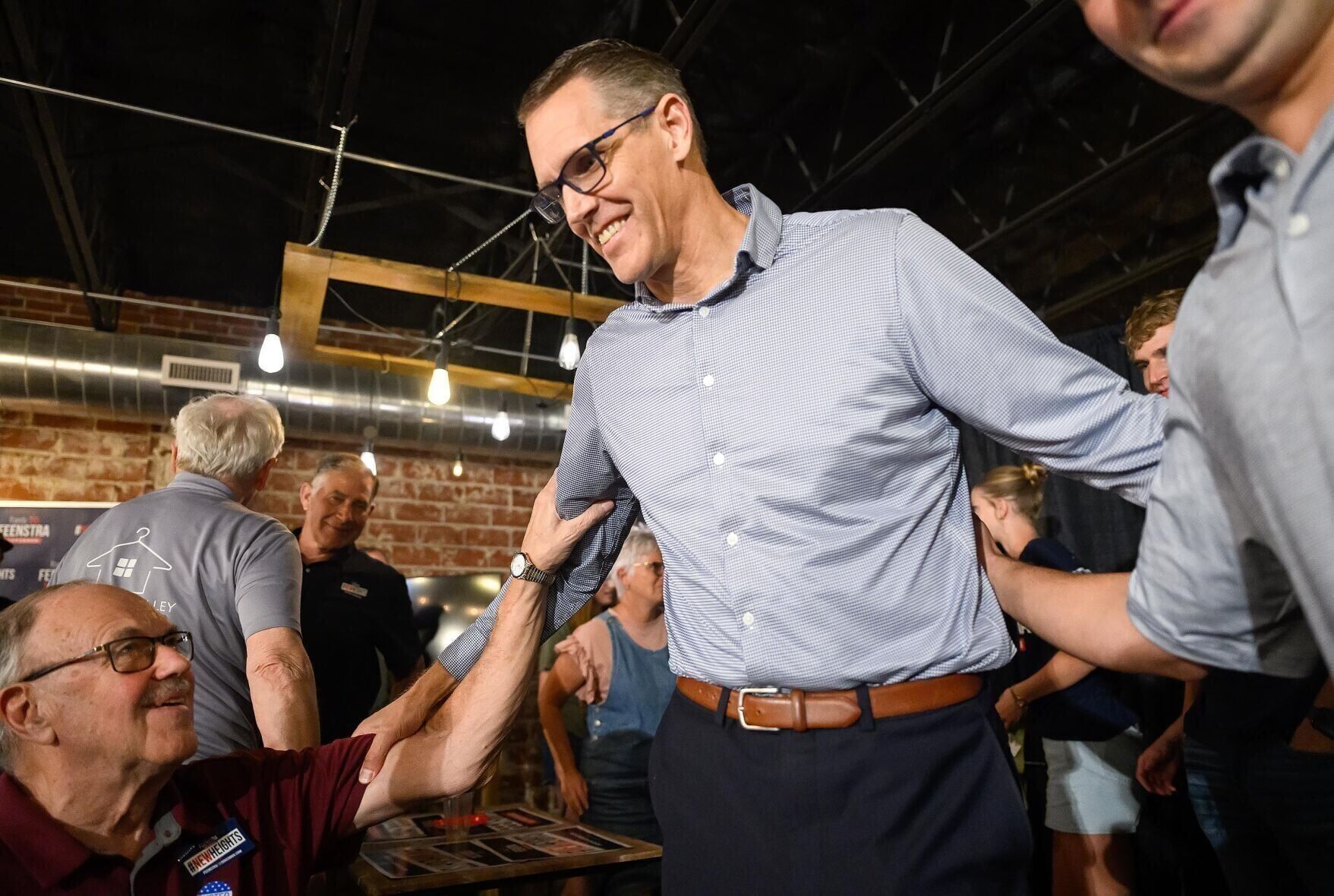
Republican Iowa gubernatorial candidate Randy Feenstra greets
supporters at his primary watch party at The Grain House in Hull on
Tuesday, June 2, 2026. Feenstra, a three-term congressman, conceded
to Zach Lahn just before 11 p.m.
Tim Hynds, Sioux City Journal
At an election watch party in his hometown of Hull, Feenstra told supporters he is "all in" to help Lahn defeat Sand.
"We gotta carry this torch, we gotta keep this state red, we gotta make sure we beat Rob Sand -- I'm all in to help him (Lahn) out," Feenstra told supporters after he led them in prayer. "The outcome wasn't what we probably wanted, but for me, and I think for everybody in this room, God's got some awesome plans."
Lahn and Feenstra were among five candidates seeking the Republican nomination in Iowa’s open-seat gubernatorial election. The other Republican gubernatorial primary candidates were former state agency director Adam Steen, pastor Brad Sherman, and state legislator Eddie Andrews.
Republican Gov. Kim Reynolds, who has held the office since 2017, did not seek reelection.
The 57-year-old Feenstra fell short in the race, despite receiving an endorsement from President Trump last Friday. Trump's support came just four days before Election Day and after more than 15,000 early votes had already been cast.
Feenstra was generally seen as the favorite to secure the party’s nomination by virtue of his familiarity in the party, having served for three terms as a congressman representing the most conservative areas of the state.
The congressman was consistently at or near the top in fundraising tallies and scored many high-profile endorsements, including former Gov. Terry Branstad, U.S. Sen. Joni Ernst, Iowa Secretary of Agriculture Mike Naig and Lt. Gov. Chris Cournoyer. Reynolds avoided making a public endorsement.
But the presumed frontrunner took heat from the other candidates about missing debates and public forums throughout the campaign. He was also criticized for saying private schools accepting state funds should "make sure they take every child," and was accused of being a "Republican in Name Only."
Lahn brought to the campaign a unique perspective on some issues, including water quality, cancer and public health, as well as strong fundraising — he was the campaign’s best fundraiser in the first four-and-a-half months of this year, according to federal campaign finance reports. He was endorsed by the Make America Healthy Again organization that is aligned with U.S. Health and Human Services Director Robert F. Kennedy Jr.’s views on public health.
During the final days before Tuesday’s primary, negative campaign ads ran against both Feenstra and Lahn, underscoring a growing belief that the race between the two was close.
Among prominent national elections forecasters, Iowa’s gubernatorial election is seen as a toss-up by the Cook Political Report and Sabato’s Crystal Ball, which announced its ratings change from “leans Republican” to toss-up on social media after Iowa’s polls closed Tuesday night. Inside Elections still rates Iowa’s gubernatorial election as “leans Republican.”
There has been scant independent, public polling on the campaign.
Iowa Republicans have held the governor’s office since 2011 and 46 out of the last 58 years, and have not lost a gubernatorial election in 20 years.
![]()
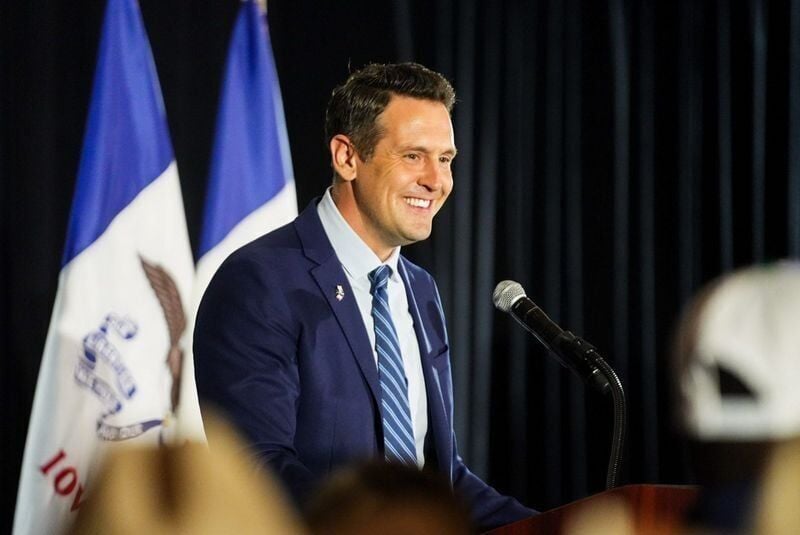
Republican gubernatorial candidate Zach Lahn speaks to
supporters during his election watch party on June 2, 2026, at the
Sheraton Hotel in West Des Moines.
Cody Scanlan, Des Moines Register
Sand and Iowa Democrats weigh in
Sand’s campaign issued a statement immediately after the polls closed Tuesday night. Sand was the only Democrat on the ballot.
“Rob Sand is entering the general election with historic grassroots momentum, a clear vision for Iowa’s future, and a campaign rooted in public service and building a better, truer Iowa,” deputy campaign manager Emma O’Brien said in the statement.
“Throughout this campaign, Rob has done what he’s always done: show up, listen to Iowans, take on the toughest challenges facing working families, and build the broad coalition needed to win in November,” O’Brien said. “No matter which flawed candidate emerges from the primary tonight — if any — they’ll still be running on the same failed agenda that has left Iowa families behind. After a decade of one-party rule, Iowans are ready to turn the page, and in November, they’ll elect Rob Sand as the next governor of Iowa.”
Speaking to supporters, campaign staff and reporters gathered at the Iowa Democratic Party’s primary night watch party in Des Moines, Iowa Democratic Party Chair Rita Hart cast the 2026 election as a rare opportunity for Democrats to regain ground in a state that has been under Republican control for roughly a decade.
Hart noted it will be the first time since 1968 that Iowa has an open U.S. Senate seat and an open governor’s race, along with competitive U.S. House contests, on the ballot this year.
“Oh, what an opportunity this is for us,” Hart said.
Hart criticized Republicans’ record in Iowa in recent years, arguing that “Republicans' reign has left our state with an economy that has been on the decline, with our hospitals closing and new cancer rates rising faster than almost any other state in the union.”
She also urged Democrats to unite behind the party’s nominees after the primary contests are decided.
“There’s going to be some winners here tonight,” Hart said. “It’s also going to be some people who are not going to win, and we're all still one family, and we're going to come together to achieve our shared goals.”
Hart credited the party’s candidate recruitment efforts and growing organizational infrastructure for producing a strong slate of candidates, saying many Democrats stepped forward because they were dissatisfied with the direction of the state. She encouraged supporters to remain engaged through the fall campaign by volunteering, canvassing and talking with voters ahead of November’s general election.